
A commercial roof rarely fails at a convenient time. A small leak can become interior damage, disrupted operations, tenant complaints, inventory loss, and an unplanned capital expense. Effective commercial roof replacement planning puts the owner back in control before water intrusion and emergency repairs dictate the schedule.
For Bay Area property owners and managers, the goal is not simply to install a new roof. It is to choose a system, scope, and construction plan that protects the building’s operations, budget, occupants, and long-term value. That requires more than comparing a few quotes. It requires a clear assessment of the existing assembly, a realistic view of risk, and accountability from the contractor responsible for the work.
Start With the Roof You Have
A replacement decision should begin with a detailed evaluation, not an assumption that visible leaks tell the full story. Water often travels through insulation, along decking, or around penetrations before it appears inside the building. What looks like one failed area may reflect broader deterioration below the roof membrane.
A qualified inspection should examine the roof covering, flashing, drains and scuppers, seams, parapet walls, expansion joints, edge metal, rooftop equipment curbs, and the condition of the insulation and deck where accessible. The assessment should also consider prior repairs. Repeated patching around seams or penetrations can signal that the system is nearing the point where repair spending no longer delivers dependable protection.
The right recommendation depends on the building. A warehouse with extensive rooftop mechanical equipment has different risk points than a retail center, office building, multifamily property, or restaurant. Drainage performance, foot traffic, grease exposure, solar equipment, wind exposure, and the building’s use all affect the replacement scope.
Define the Business Case Before Selecting Materials
Every roof replacement has a cost. The larger financial question is what delay may cost. Deferring replacement can be reasonable when a roof has isolated damage and sufficient remaining service life. It becomes risky when leaks are recurring, repairs are multiplying, insulation is saturated, or the system can no longer be expected to protect the structure through another wet season.
Build the project budget around the complete scope, not just the membrane price. Removal and disposal, damaged deck replacement, insulation upgrades, flashing, drain work, code-required improvements, access constraints, permits, and temporary weather protection can all affect the final investment. A transparent estimate identifies these variables early and explains what is included, what may be concealed until tear-off, and how change conditions will be handled.
Property owners should also account for the value of reduced uncertainty. A low initial bid can become expensive if it excludes critical details, relies on weak materials, or leaves existing problems buried beneath a new surface. Commercial roofing is a building-envelope investment. The system is only as dependable as its preparation, transitions, drainage, and installation quality.
Commercial Roof Replacement Planning for Operations
The best roofing system can still create avoidable problems if the installation plan ignores the people and business beneath it. Commercial roof replacement planning should map the project around the property’s daily operations before materials arrive on site.
For an occupied building, establish work hours, access routes, staging areas, parking impacts, loading-dock restrictions, noise-sensitive periods, and areas where debris protection is required. Tenant communication should be specific. People need to know when work will occur, whether entrances or parking areas will be affected, and who to contact if they notice a concern.
Interior protection matters as well. Tear-off can disturb dust, vibration, and occasional odors, particularly with certain asphalt-based systems. Sensitive environments such as medical offices, food-service spaces, schools, and data rooms may require additional sequencing or containment measures. If rain is possible during construction, the contractor should explain how open sections will be secured at the end of each workday and what contingency plan is in place for changing weather.
A disciplined contractor does not treat logistics as an afterthought. Clear planning reduces disruption, protects the property, and gives owners a realistic timeline rather than a vague promise.
Choose a Roofing System for the Building, Not the Trend
Material selection should reflect the roof design and performance demands. There is no single best commercial roof for every property.
TPO single-ply membranes are a strong option for many low-slope roofs. Their reflective surface can support energy-efficiency goals, and heat-welded seams provide dependable protection when installed correctly. TPO may be especially practical for buildings seeking a clean, durable membrane system with manageable maintenance requirements.
A 3-ply torch-down system can provide layered protection and may be appropriate where a multi-ply modified bitumen assembly aligns with the building’s needs. These systems require precise installation and careful attention around details, transitions, and fire safety. They are not interchangeable with single-ply systems simply because both cover flat or low-slope roofs.
Restorative silicone coating systems can be valuable when an existing roof is still structurally sound and dry enough to qualify. A coating can extend service life, improve reflectivity, and reduce the disruption of a full tear-off. But a coating is not a cure for widespread wet insulation, failing substrate, or major drainage defects. Applying a coating over an unsuitable roof can postpone a necessary replacement while trapping problems beneath the surface.
The final decision should consider expected service life, maintenance needs, drainage, insulation goals, rooftop traffic, warranty requirements, and the building owner’s hold period. A property being retained for decades may justify a different investment than one scheduled for sale within a few years.
Address Insulation and Drainage While the Roof Is Open
Roof replacement provides a rare opportunity to improve components that are difficult to access later. Insulation is one of them. Upgrading insulation can improve thermal performance, support code compliance, and help stabilize indoor comfort. In some cases, tapered insulation can also improve drainage by directing water toward drains or scuppers.
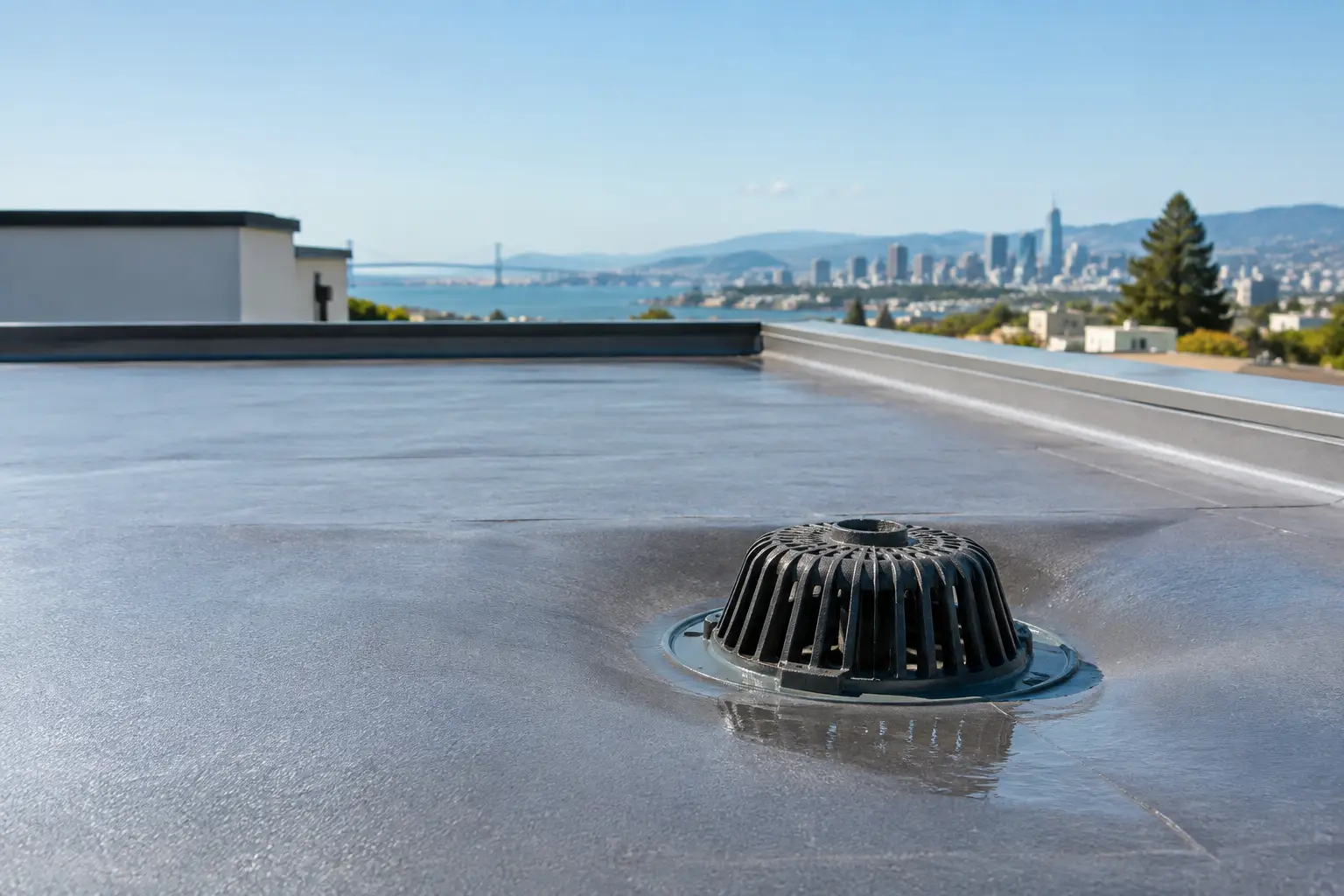
Ponding water deserves careful attention. It accelerates wear, adds weight to the roof assembly, and can expose weak details over time. A new membrane installed over poor drainage may look finished on day one but inherit the same long-term vulnerability. The solution may involve tapered insulation, drain modifications, additional drains, overflow improvements, or localized slope correction. The appropriate approach depends on the roof structure and existing drainage layout.
Flashing and edge details should receive the same scrutiny as the field membrane. Roof failures frequently occur at walls, curbs, pipes, drains, and perimeter edges because these areas move, collect water, and endure concentrated stress. Premium materials matter, but precision at these transitions is what turns materials into a protective system.
Verify Contractor Accountability Before Work Begins
A proposal is not the whole project. Owners should understand who will supervise the work, how quality checks are documented, what safety practices will be followed, and how the contractor will communicate throughout construction. Commercial properties deserve direct answers, especially when a roof replacement affects tenants, equipment, and revenue-producing operations.
Confirm that the contractor carries appropriate liability insurance and can provide the protections required for the project. For larger or higher-risk scopes, contract performance bond protection may add another layer of confidence. Review the written warranty carefully as well. Ask what is covered, what maintenance obligations apply, and whether the warranty addresses both materials and workmanship.
It is also reasonable to ask how concealed deck damage, wet insulation, or unforeseen conditions will be documented and priced. No contractor can see every hidden condition before tear-off. A trustworthy process makes those possibilities clear upfront and provides a defined approval path rather than surprising the owner after work has started.
Build Maintenance Into the Replacement Decision
A new roof is not a set-it-and-forget-it asset. Regular inspections, drain cleaning, debris removal, and prompt attention to punctures or damaged flashing help preserve the system and protect warranty coverage. Rooftop service contractors should be instructed to avoid unauthorized penetrations and to report any damage created while servicing equipment.
Keep project records, warranty documents, repair history, and inspection reports in one property file. This documentation supports future maintenance decisions, helps with insurance discussions, and gives prospective buyers a clearer view of how the asset has been protected.
Titanium Roof Innovations approaches commercial roofing with the same standard that owners expect from a major capital improvement: clear scope, disciplined craftsmanship, and protection that extends beyond installation day. The most valuable planning decision is often the earliest one – schedule a professional assessment while replacement remains a controlled investment, not an emergency response.